Filming Composers: John Kefala-Kerr talks about creating music for the Steamsong Opera

composer john kefala kerr talks about creating music for the steamsong opera vimeo thumbnail

Over the past few months, I’ve been focused on filming composers at work, and one of the most fascinating projects has been my short interview with composer John Kefala-Kerr in his studio.

John is currently deep into composing music for his upcoming opera, Steamsong. As someone who loves filming composers and documenting creative processes, it was inspiring to witness his unique approach as he transforms the evocative sounds of steam locomotives into a modern operatic score.

Steamsong is scheduled to premiere at the Gala Theatre in Durham as part of the Brass Festival. At the time of our filming, the opera was still very much a work in progress, with John developing the score and refining sonic ideas drawn from field recordings. The performance is set for July 17, 2015. As John explained during our conversation, the piece combines recorded steam sounds, live choir, brass ensemble, and soloists to tell a story that bridges industrial heritage and contemporary musical expression—a perfect subject for anyone interested in filming composers exploring new creative territory.


Filming Composers: John Kefala-Kerr in His Creative Studio for Steamsong Opera
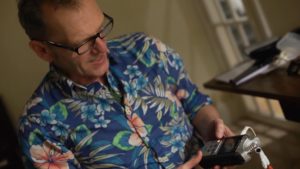
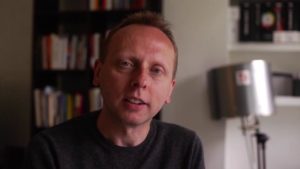
John Kefala-Kerr talks about his creative process

One of the most compelling moments of our interview came when John described how a trip to York’s National Railway Museum sparked a crucial musical element for Steamsong. Standing about ten feet from a steam locomotive, he recorded the whistle as it gradually built pressure. Initially, the sound was weak, with “a kind of hiss” and buffeting wind noise captured in the microphone. As the locomotive reached full pressure, the whistle finally produced its powerful, haunting tone.

“So there’s quite a lot of wind noise in that. So you get the, you know, all that kind of buffeting sound. That was a windy day. And so the, the job really was to try and clean that up,” John shared. “The thing I was aiming for really was a kind of a serial sound. There’s a lot of hiss in it as well, which is the sort of propulsion of steam through the whistle itself.”

John detailed how he used software tools on his laptop to clean up the audio, reduce hiss, and transform the whistle’s pitch. From this raw steam sound, he extracted harmonies that became the building blocks for sections of the opera’s choral writing—a fascinating example of the hidden detail captured when filming composers in their workspace.

“The idea here is to try to make the whistle evoke something more than the train, something that sounds a bit like a voice, like a distant voice, something that comes out of the ether, almost.”

In the film, John demonstrates the translation of these industrial sounds into musical language. On the piano, he played a chord derived directly from the steam whistle’s harmonic content, explaining that the choir’s opening lines in Steamsong are built entirely from this motif.

“The whole passage of music for the choir is constructed out of that idea, just using the train whistle. The train whistle harmony and translating it into human voice.”


Filming Composers: John Kefala-Kerr manipulates sounds
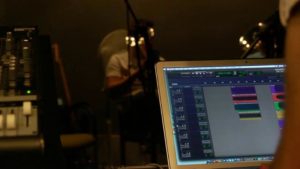
Composer John Kefala-Kerr manipulates sounds

This creative process reflects John’s signature style—something that makes filming composers like him so compelling. He seamlessly weaves environmental sounds, technology, and traditional instruments into experimental yet emotionally resonant music. In Steamsong, the train whistle is not merely a mechanical artifact but becomes a kind of ethereal, human-like voice, bridging past and present.

While filming composers like John, I’m constantly struck by the meticulous attention to sonic detail and the deep commitment to evoking place and history. The Steamsong opera seems poised to be a striking and immersive piece, fitting perfectly within the Brass Festival, which has long celebrated innovative collaborations between contemporary composers and brass musicians.

I’m looking forward to filming the live performance at the Gala Theatre and capturing how these studio experiments come alive on stage. For anyone interested in filming composers, new music, industrial history, or the creative processes behind large-scale musical works, Steamsong promises to be an unforgettable experience.

You can explore more of my films about artists and creative processes here: Artist Films

Artist Video Production~Flow Public Opening

flow public opening vimeo thumbnail

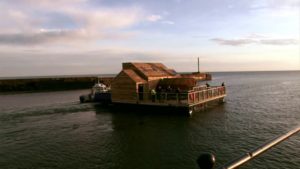
On Sunday 25th March 2012, the River Tyne hosted the striking public launch of ~Flow, a floating tidal-powered artwork created by Owl Project and Ed Carter.

As part of Artists Taking the Lead—a major initiative from the UK Arts Councils for the London 2012 Cultural Olympiad—this ambitious structure brought together art, engineering, music, and sustainability. This video montage represents a distinctive example of artist video production, designed to document and reflect the creative pulse of large-scale public art in action.

Positioned just upriver from the Tyne Bridge, ~Flow was both a functioning vessel and a responsive musical instrument. Powered by the tidal energy of the River Tyne, it converted real-time environmental data—like flow speed and salinity—into sound through bespoke wooden machines created by Owl Project. These handmade devices translated river conditions into constantly shifting musical compositions, giving visitors a unique experience of nature interpreted through art and sound.

The launch event offered a full day of public engagement and hands-on participation. Hundreds of visitors explored the floating structure via guided tours, took part in interactive workshops, and met the artists and engineers behind the project. The atmosphere along the Newcastle Quayside was energetic and open, a joyful blend of science fair, performance, and festival.

Documenting Public Art in Action

As a filmmaker, I specialise in artist video production that captures these kinds of shared cultural moments. For me, this wasn’t just about recording an event—it was about sensing its rhythm, observing its details, and preserving its atmosphere. My approach focused on keeping the camera unobtrusive while highlighting the interaction between people, environment, and sound.

This approach is especially important when documenting public art, where the setting, audience engagement, and atmosphere are integral to the artwork’s success. ~Flow wasn’t designed to exist in isolation—it needed people to step aboard, listen, explore, and play. Capturing those real-time responses gives the artwork a second life, enabling it to reach audiences far beyond the banks of the Tyne.

But the most memorable moment of the day came in the evening, with a live, improvised performance by world-renowned saxophonist Andy Sheppard and Mercury Prize-nominated drummer Seb Rochford. Performing from the deck of ~Flow itself, they responded in real time to the evolving sounds generated by the river-powered instruments. The result was an extraordinary, one-off collaboration where human improvisation met environmental feedback.


Artist Video Production: Capturing the Launch of ~Flow on the River Tyne
A screengrab from the video showing one of the handmade speakers onboard ~Flow

Witness the Performances

You can experience that live performance in the video above. The interplay between Sheppard’s soulful saxophone and Rochford’s inventive percussion was rich, exploratory, and beautifully restrained—both artists responding not just to each other, but to the ambient tones generated by the river’s flow. Their set made ~Flow come alive as a collaborative instrument, fusing technology, nature, and improvisation into a single, compelling experience.

Capturing this performance on film required responsiveness and restraint. I wanted to convey the emotional subtlety of the music while keeping the focus on the artists’ dialogue with the vessel. This is the core of artist video production: to witness creative process in real time and reflect it faithfully for others.

The ~Flow project was curated and produced by Beth Bate and Tom Higham, who brought together artists, musicians, and communities to develop a bold, interdisciplinary programme. Their vision ensured that ~Flow was not just a static sculpture, but a hub for creative experimentation, dialogue, and exchange.

Why Projects Like This Matter

For me as a documentary filmmaker~Flow exemplifies why I do what I do. It’s a perfect blend of art, environment, music, and community—all areas I’m passionate about. Working on projects like this reminds me that filmmaking isn’t just about cameras and edits—it’s about bearing witness to creative encounters and giving them space to resonate long after the moment has passed.

Whether I’m working on research collaborations, artist commissions, or environmental installations, I approach each project with the same mindset: to elevate the voices and experiences that might otherwise be missed. ~Flow is a lasting reminder of how public art can connect people, place, and purpose—and how video can help carry those connections into the future.

🌐 Learn more about the ~Flow project at: www.flowmill.org

🎨 Explore more of my work documenting artists and creative practice here: https://alanfentiman.co.uk/artists-culture/