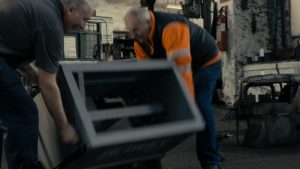
Heritage Skills in Education Project 2013

heritage skills in education project 2013 vimeo thumbnail

In 2013, I was commissioned by the North of England Civic Trust to create a short film as part of their Heritage Skills in Education project—an experience that marked a standout moment in my work in heritage documentary filmmaking.

This Heritage Lottery-funded initiative ran across schools, colleges, and universities throughout the North East. It introduced young people to the principles of conservation, repair, and adaptive reuse of historic buildings—connecting practical heritage documentary filmmaking with real career pathways in traditional building skills.

Filming took place at a range of locations, from the South Mill in Durham to Victorian buildings and John Dobson-designed churches. At each site, students engaged with buildings not just as visitors, but as future stewards—asked to develop renovation ideas, draw up conservation plans, and propose modern uses, like converting spaces into restaurants or creative venues.

The programme wasn’t about theory alone. Through hands-on sessions, students worked directly with experienced craftspeople. I captured them cutting and assembling stained glass, pointing lime mortar into historic brickwork, and trying their hand at woodcarving and stone masonry. These traditional building skills—rarely taught in classrooms—came to life on camera. One tutor summed up the aim clearly: “We want them to see what’s involved—what stone feels like, how chisels work, how a mason brings something to life from an idea to a template to the finished stone.”

To document this authentically, I kept the filming setup small—using a Panasonic AF101 and GH2, lapel mics, and handheld lights—allowing me to move through workshops without interrupting the rhythm. It let me focus on the quiet but significant moments: the spark of understanding when someone mastered a technique, or the pride in holding up their first carved letter or leaded pane. These are the kinds of real human interactions that heritage documentary filmmakingis built to capture.

The film includes contributions from both tutors and students. One teacher reflected, “If we’re not careful, we’ll have a generation that can’t cut wood or measure accurately. These sessions help students build real-world awareness.” Another described the students’ journey from shy newcomers to confident presenters with “amazing interviewing skills” by the end of the programme.

Students, too, reflected on the depth of the experience. “It’s nice to try a new craft—something we don’t get to do in school,” said one. Others saw links to architecture, engineering, and their broader academic subjects. One participant noted, “I didn’t think I’d be good at this. Now I can imagine doing something like it for real.” Experiences like these are the raw material of effective heritage documentary filmmaking.


Heritage Documentary Filmmaking: Capturing the ‘Heritage Skills in Education 2013’
Filming an interviewing one of the participants

The impact extended beyond technical skills. Educators saw huge growth in social confidence, spatial awareness, and creative thinking. Several students developed design concepts, modelled structures, and made group presentations on their proposals. A lecturer commented on how “the whole curriculum became more holistic,” with students able to relate their coursework to tangible heritage challenges and apply traditional building skills in a meaningful context.

The film ends with a poignant reminder from one of the stonemasons: “I learnt from my dad, who started in 1963. Now I’m passing on a little bit of what he taught me. You leave something behind you.” That quote stuck with me. It captured the essence of both the project and the purpose of filming it—to preserve not only buildings but the knowledge and care that sustain them.

This was more than a documentary commission. It was a chance to show the value of traditional building skills and how heritage isn’t just history—it’s an active, living practice that needs to be handed on. That’s what makes heritage documentary filmmaking so vital. It bridges generations, and, in this case, inspired a new one to pick up tools, learn skills, and build futures.

To explore more of my heritage documentaries, visit:

👉 https://alanfentiman.co.uk/heritage-museums/